


12 & 24 Hour Pharmacy Shipper Range
PROJECT BACKGROUND
A major member-based Australian pharmacy group sought a consistent cold chain packaging approach across its multi-state retail network.
Its medicine shipments covered different parcel sizes and delivery windows. The commercial objective was to match the level of thermal protection to each shipment while keeping packaging selection and assembly straightforward for pharmacy teams.
Rather than applying one over-specified solution across every shipment, Thermogard set out to develop a structured range that would allow pharmacies to select packaging based on two simple variables: payload size and required delivery duration.
PROJECT REQUIREMENTS
The brief required medicines to remain between 2°C and 8°C across four common parcel sizes, with both 12-hour and 24-hour delivery options.
Each configuration needed to demonstrate the required thermal performance under an ISTA 7E Summer profile while accommodating the required payload volume and maintaining a practical balance between performance and cost.
The shorter-duration shipments called for an economical insulation system without unnecessary material, while the longer-duration shipments required greater protection against extended summer exposure.
Clear packout specifications were also essential. Pharmacy teams needed to be able to select the appropriate carton size and service duration, then follow a repeatable assembly process without making thermal design decisions at the packing bench.
UNIQUE PROJECT CHALLENGES
Thermal performance does not increase in direct proportion to carton size or coolant quantity. Changes in internal volume, exposed surface area, packout geometry and heat transfer through the packaging all affect how long a payload remains within its required temperature range.
This was demonstrated clearly during modelling. The Size 3 EnviroFoil configuration, using eight 500 g gel packs, maintained the payload between 2°C and 8°C for the full 24-hour profile, while the other EnviroFoil formats achieved approximately 12 to 13 hours. The result showed that coolant quantity alone could not be used to predict performance across different carton sizes.
The engineering challenge was therefore to balance these variables across two service windows. The longer summer shipment required greater thermal protection, while the shorter option needed to avoid unnecessary insulation and cost.
Component standardisation also had to accommodate differences in thermal margin between sizes. Each packout therefore required individual assessment rather than simply scaling a single design across the range.
THERMOGARD SOLUTION
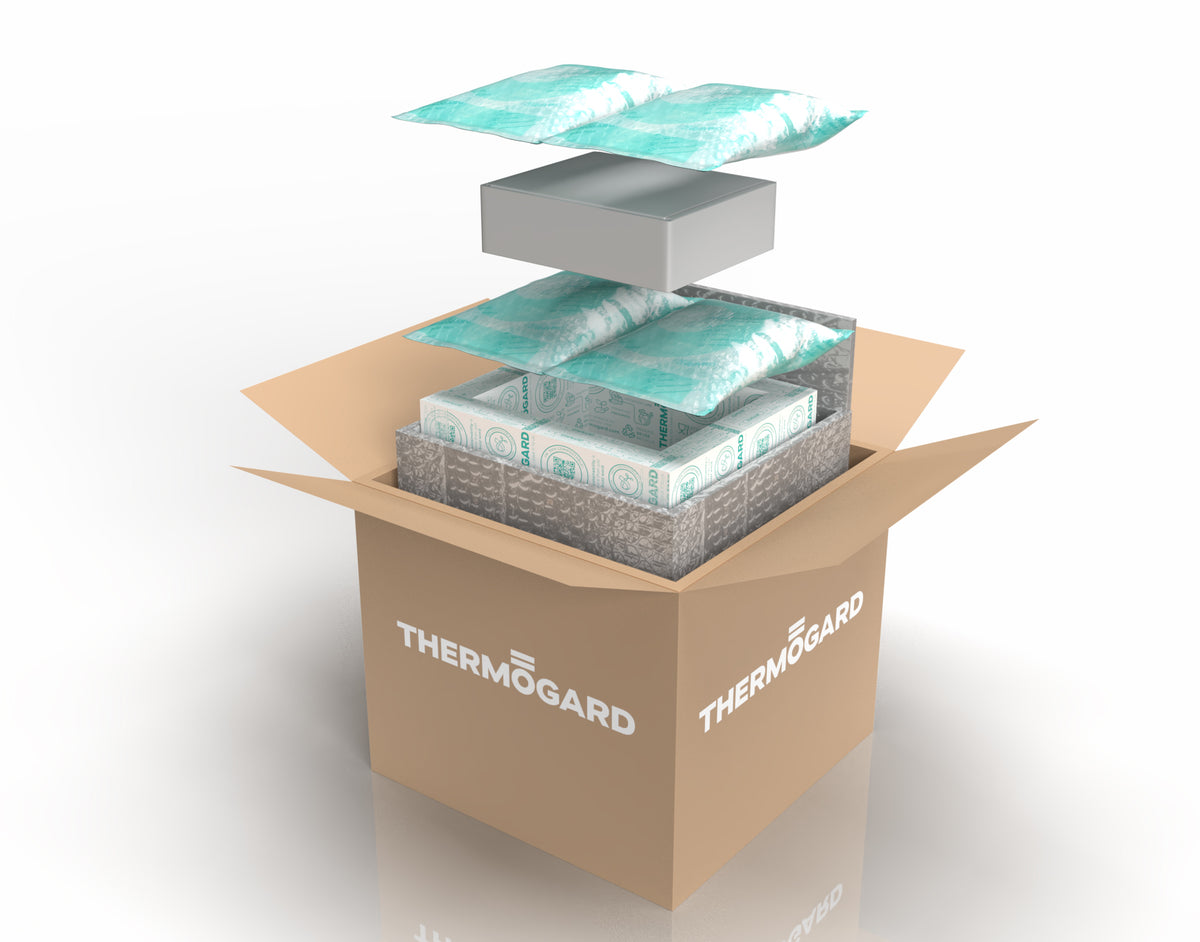
Thermogard developed a two-tier packaging architecture using a common family of corrugated cartons and a common 500 g bubble-backed gel pack format.
For the 12-hour service level, each carton was paired with a fitted EnviroFoil pouch, providing a lightweight and cost-effective insulation system for shorter-duration shipments.
For the 24-hour service level, the same carton family and coolant format were paired with 800 gsm wool liners to provide greater thermal protection for the longer delivery window, while also incorporating a 100% biodegradable insulation inner.
Coolant quantities were prescribed by carton size:
• Size 1: four 500 g gel packs
• Size 2: five 500 g gel packs
• Sizes 3 and 4: eight 500 g gel packs
Using a common coolant format across both service levels simplified component selection and procurement while allowing insulation type and coolant quantity to be matched to the thermal requirements of each configuration.
Thermogard used ThermalIQ digital-twin modelling to rapidly prototype and refine each packout against a consistent summer profile. This allowed the engineering team to compare configurations, identify differences in predicted performance and determine where thermal margin required closer attention before physical qualification.
The resulting packouts required no divider components, helping to keep assembly simple and repeatable across the pharmacy network.
VALIDATION
All eight concepts were assessed in ThermalIQ against a 24-hour ISTA 7E Summer profile.
Saline water was used as the medicine surrogate. Payloads began at 3°C, packaging materials at 20°C and gel packs at -10°C. Modelled probes monitored both payload and internal air temperatures throughout the profile.
Every EnviroFoil configuration achieved at least the intended 12-hour service window. Sizes 1, 2 and 4 maintained the required 2°C to 8°C range for approximately 12 to 13 hours, while Size 3 remained within range for the full 24-hour profile.
Within the wool-lined range, Sizes 1, 3 and 4 achieved the full 24-hour target. Size 2 reached approximately 23 to 24 hours, identifying it as the configuration with the tightest modelled margin and a priority for confirmation during subsequent physical qualification.
END RESULT
The design programme produced eight clearly defined packouts across four carton sizes and two service levels.
A common carton family and gel pack format simplified component selection, while the two insulation systems allowed thermal protection to be matched more closely to the required delivery window.
For the pharmacy group, this created a straightforward specification framework: select the appropriate carton size, select the required shipment duration, and use the corresponding defined packout.
The modelling demonstrated at least 12 hours within the required temperature range across all EnviroFoil formats and approximately 23 to 24 hours across the wool range. It also identified where thermal margin was strongest and where further qualification attention was required.
The result was a scalable cold chain range designed around operational simplicity, component commonality and fit-for-purpose thermal performance, providing a clear basis for subsequent physical qualification and deployment across the pharmacy network.
Read more

A major Australian pathology provider needed a more reliable way to move temperature sensitive diagnostic specimens across its collection and laboratory network. Thermogard reviewed the full transp...

The central challenge was consistency across 15 fulfilment sites. The client was already shipping temperature sensitive medicines at scale across North America, but variations in coolant conditioni...
Thermogard was engaged by one of the largest pharmacy shippers in the United States to develop a compact cold chain packaging solution for temperature-sensitive pharmaceutical shipments moving thro...