


Reusable Pathology Specimen Transport System
PROJECT BACKGROUND
What began as a discussion around a new packout with a major Australian pathology provider soon revealed a broader challenge across its specimen transport process.
The client required strict temperature control for diagnostic specimens moving across a broad network of collection sites and central laboratories, where insulation was limited, coolant performance varied and handling practices introduced additional temperature risk.
Any new solution therefore needed to address the full operating process, with greater control over thermal performance, compliance and repeatability from collection through to laboratory receipt.
The existing chilled packout used aluminium specimen cans with loose ice packs and no insulation. One observed regional to central laboratory shipment reached its destination in roughly 20 hours, representing a favourable lane, yet some coolant was already completely spent on arrival. Once received, samples were transferred into uncontrolled tubs on the bench, creating another exposure point before laboratory processing.
PROJECT REQUIREMENTS
The immediate requirement was to establish a reliable 2°C to 8°C transport platform for clinically important diagnostic specimens, with enough duration to protect regional and air freight lanes while remaining practical for daily laboratory use. The system also needed to address UN3373 transport gaps identified in the existing secondary packaging, including absorbent material and separation or protection for individual vials.
Thermogard also needed to solve for network operations. The preferred system had to be reusable, simple to load, easy to carry, robust enough for repeated courier handling and available in multiple payload sizes. A central requirement was to reduce dependence on loose coolant placement and operator judgement by using a defined PCM configuration that could be conditioned and rotated through the network.
The frozen stream was treated separately. Existing use of water based gel products as a substitute for dry ice could not provide genuinely frozen transport because the coolant changes phase around 0°C. The reusable 5°C PCM concept was therefore designed for the chilled specimen network, with frozen shipments requiring their own validated dry ice or frozen solution.
UNIQUE PROJECT CHALLENGES
One of the first issues was the way thermal performance had been judged. Whether a shipment was considered cold enough depended largely on whether ice remained in the coolant on arrival. That provided only a rough indication of residual cooling capacity, not evidence that specimens had remained within 2°C to 8°C throughout the journey. Five days of current state logger data showed why that distinction mattered: temperatures moved rapidly once samples left controlled refrigeration, with several profiles failing to establish or hold the required chilled range.
The second challenge was the receiving process. Product temperature was not always captured at the point of unpacking; in some cases it was recorded later by laboratory staff after specimens had already been placed on dry ice. That made it difficult to distinguish transport performance from post arrival handling and weakened the evidence available for root cause analysis.
The third challenge was scale. A reusable shipper only works if the thermal hardware and return logistics are designed together. PCM panels need enough conditioning time before use, sites need space and equipment to store them, and a used set must be able to return without interrupting outbound shipments. The project therefore had to create a closed loop operating model, not just a high performance container.
THERMOGARD SOLUTION
Thermogard began with a current state review of the packaging, sample handling and temperature data, then separated the problem into three layers: specimen containment and UN3373 readiness, chilled thermal control, and network logistics. That made it possible to correct compliance and handling gaps without confusing them with the thermal performance of the reusable shipper.
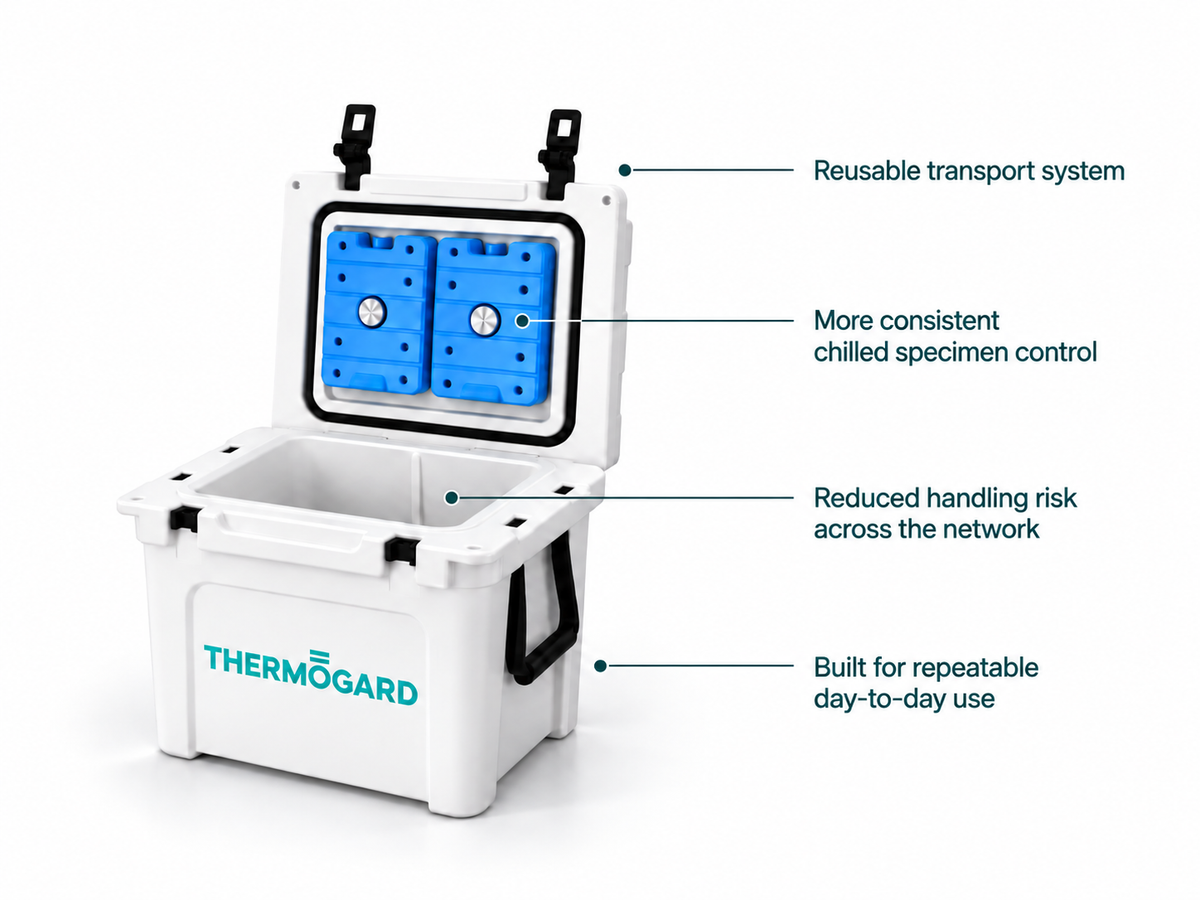
For the chilled network, Thermogard proposed the VitaCell R-15, a rugged reusable shipper platform designed around 5°C phase change material panels. The fixed PCM architecture replaced loose water based coolant with a controlled thermal mass positioned around the payload, while the approximately 20 mm insulated wall, robust lock points and carry features were designed for repeated courier use. The platform was drop test approved and designed for long term repeated use.
Three sizes allowed the same operating logic to cover different specimen volumes, providing 14 L, 23 L and 41 L of payload capacity with four, six and ten PCM panels respectively. This gave the network a common thermal platform without forcing smaller specimen loads into oversized containers.
Just as important, Thermogard mapped the PCM circulation model. The proposed network used three PCM sets for each VitaCell: one conditioned and ready for dispatch, one in circulation or return, and one undergoing the minimum conditioning period. Regional sites would hold dedicated PCM storage racks and suitable conditioning equipment, while returned ambient panels could be rotated back into conditioning. This separated shipper turnaround from PCM conditioning time and reduced the risk that operational pressure would lead to partially conditioned coolant being used.
The packaging review also identified the need for absorbent material and separation around individual vials within the secondary pack. In the finished operating model, those specimen protection functions sit inside the reusable tertiary shipper, so compliance, mechanical protection and thermal control are treated as complementary layers rather than asking the outer container to do everything.
VALIDATION
The VitaCell R-15 platform was presented with demonstrated thermal performance beyond 48 hours using 5°C PCM panels, together with drop test approval. The concept presentation represented the initial solution and validation stage rather than final qualification of every customer lane, so the next step was to match the selected shipper size, PCM quantity and operating SOP to the network's real routes and handling conditions.
This distinction mattered because the current state data had already shown that route timing alone was not enough. Qualification needed to include the handoffs that were driving exposure: time on the bench, courier collection, airport dwell, air transport, receiving and transfer into the laboratory. Temperature capture at receipt also needed to become part of the process so the organisation could verify specimen condition before any post arrival cooling altered the evidence.
END RESULT
The project reframed a recurring transport problem as a system design problem. Instead of relying on aluminium cans, loose ice packs and favourable transit times, the proposed model established a reusable chilled platform with defined PCM mass, known payload capacity and a repeatable conditioning cycle.
It also created a clearer separation between chilled and frozen transport. Chilled pathology specimens could move in a 5°C PCM system designed for more than 48 hours of protection, while genuinely frozen samples could be directed into a separate dry ice or validated frozen pathway rather than relying on water based gel products.
Operationally, the strongest outcome was standardisation. Three shipper sizes, one reusable platform, defined PCM quantities and a three set coolant rotation model gave the network a practical basis for SOPs, training and asset management across multiple sites. For pathology networks, where specimen integrity depends as much on handoffs and handling as on the container itself, that repeatability is what turns thermal packaging into a reliable part of the diagnostic process.
Read more

The central challenge was consistency across 15 fulfilment sites. The client was already shipping temperature sensitive medicines at scale across North America, but variations in coolant conditioni...

A major member-based Australian pharmacy group sought a consistent cold chain packaging approach across its multi-state retail network.
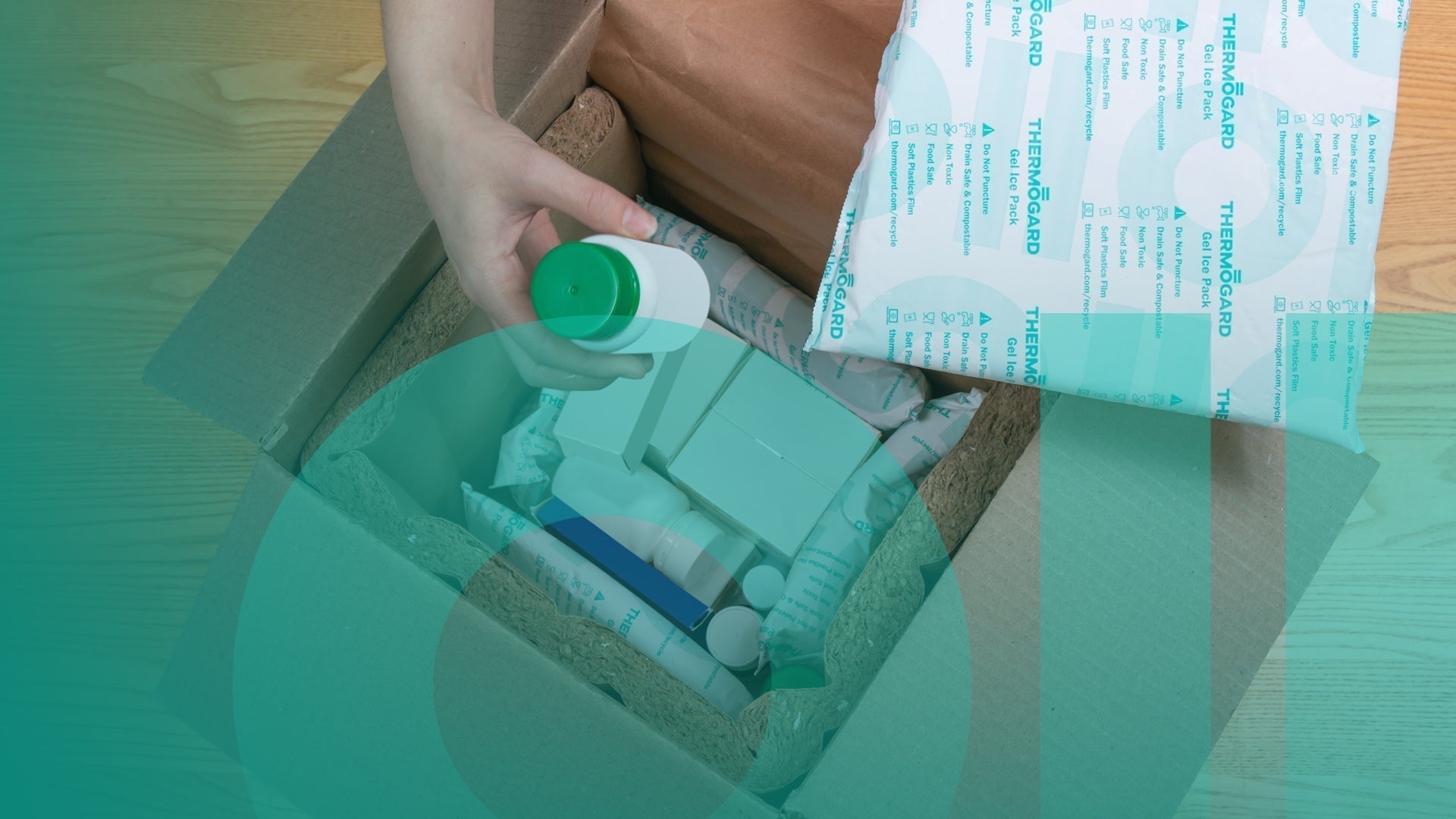
Thermogard was engaged by one of the largest pharmacy shippers in the United States to develop a compact cold chain packaging solution for temperature-sensitive pharmaceutical shipments moving thro...