

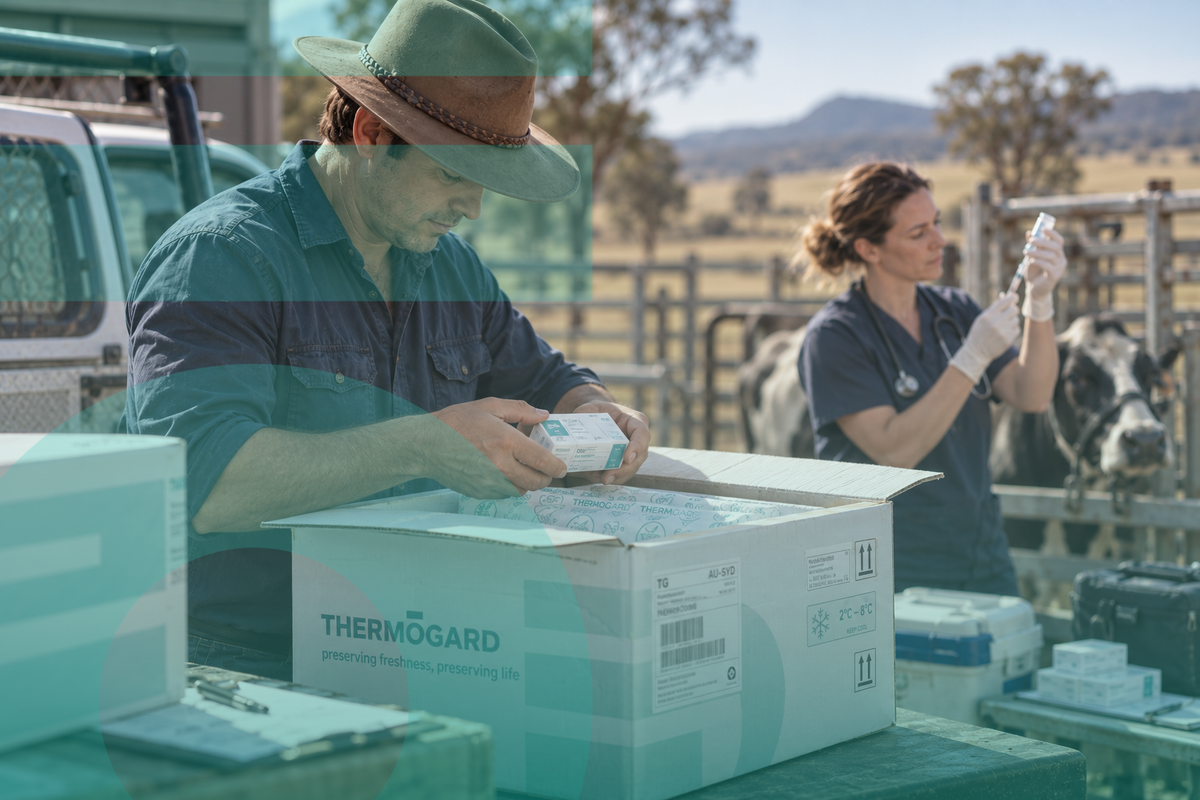
Recyclable Veterinary Shipper Range
PROJECT BACKGROUND
Veterinary vaccines and medicines often pass through manufacturers, wholesalers, logistics providers, and regional depots before reaching a clinic. A common packaging standard across that network gives an animal health manufacturer greater control over product efficacy, temperature data, compliance, and brand stewardship.
A global animal health partner required a recyclable replacement for an established range of expanded polystyrene shippers. The programme covered 5 kg, 15 kg, and 20 kg formats used for temperature sensitive pharmaceutical products. The new range needed to retain practical payload capacity and established external dimensions while improving sustainability and maintaining 2°C to 8°C performance for at least 48 hours.
PROJECT REQUIREMENTS
The project required more than a direct material substitution. Three shipper volumes, 12 L, 38 L, and 55 L, needed a consistent architecture using recyclable insulation, standard gel coolant, and repeatable barrier placement. The 15 kg and 20 kg formats also had to retain their outer dimensions so downstream processes were not disrupted.
The system needed to support future standardisation across distributors, logistics providers, and direct shipments while balancing thermal performance, payload fit, material availability, and pack out simplicity.
UNIQUE PROJECT CHALLENGES
Baseline modelling showed that none of the existing 35 mm polystyrene formats maintained the required temperature range for the full 48 hour ISTA 7D Summer profile. The 5 kg shipper remained within 2°C to 8°C for 38.12 hours, the 15 kg format for 36.2 hours, and the 20 kg format for 45.4 hours.
The middle format was the weakest performer, showing that thermal performance did not scale in a straight line with box volume. Payload geometry, internal air space, coolant position, surface area, and thermal mass all influenced the result.
Operationally, the range had to fit an established distribution model spanning wholesalers, logistics providers and veterinary channels. The 15 kg and 20 kg formats needed to retain their existing external dimensions, while the new system also had to be simple enough to pack consistently across different operators and locations. Any redesign therefore had to improve sustainability without creating new storage, handling or revalidation burdens.
THERMOGARD SOLUTION
After modelling the existing performance, Thermogard determined that the new range could not be treated as a like for like material substitution. The existing EPS architecture was set aside and two recyclable insulation platforms were engineered around the payload, required duration and practical constraints of each format.
The paper solution used 35 mm PaperShield Ultra in an A/B liner format with 5 mm dividers. A premium alternative used 35 mm EnviroShield in an L pad configuration with matching dividers. Both systems used standard 1 kg gel packs with controlled separation from the payload, creating a common packing logic across the range.
The 5 kg format used four gel packs and both material options maintained 2°C to 8°C for more than 48 hours. At 48 hours, the PaperShield Ultra design recorded 7.1°C and the EnviroShield design recorded 5.9°C. The 20 kg format used eight gel packs and also achieved more than 48 hours with both insulation systems, recording 7.6°C and 6.8°C respectively at the 48 hour point.
For the 15 kg format, six gel packs extended performance from the 36.2 hour baseline to 43.3 hours with PaperShield Ultra and 45.3 hours with EnviroShield. The modelling isolated the remaining gap and provided a clear basis for the next iteration.
END RESULT
The programme established two credible pathways away from expanded polystyrene: a curbside recyclable paper fibre system and a robust PET system made from recycled material with the potential for repeated use. Both used the same standard coolant format and clear barrier logic.
The 5 kg and 20 kg shippers achieved the full 48 hour requirement with both insulation options, while the 15 kg format gained between 7.1 and 9.1 hours of additional time in range. The results converted a broad sustainability objective into a measured engineering programme, showing where direct substitution was possible and where further optimisation would create the final performance margin.
Beyond thermal performance, the project created a more standardised operating model: common 1 kg coolant, defined barrier placement, recyclable insulation options and shipper formats designed around existing downstream dimensions. This reduced the number of variables distributors and logistics partners would need to manage while giving the manufacturer greater ownership of packaging specifications across its network.
GALLERY

Read more
Direct to patient pharmacy suppliers often move very small, high value payloads through ordinary parcel networks. A syringe or vial may occupy only a fraction of the shipper, yet the system must ke...
Thermogard was engaged by one of the largest pharmacy shippers in the United States to develop a compact cold chain packaging solution for temperature-sensitive pharmaceutical shipments moving thro...

A major member-based Australian pharmacy group sought a consistent cold chain packaging approach across its multi-state retail network.