

National Scale 36 Hour Pharmacy Shipper Case Study
PROJECT BACKGROUND
Thermogard was engaged by one of the largest pharmacy shippers in the United States to develop a compact cold chain packaging solution for temperature-sensitive pharmaceutical shipments moving through the parcel network.
The challenge was not simply maintaining temperature for 36 hours. The pharmacy needed a shipper that could be packed quickly and consistently in a space-constrained, high-volume fulfillment environment, while performing against a recognized summer parcel profile without freezing the medicine at the start of the journey or allowing it to warm beyond specification at the end.
With a small payload, fixed service window, and fast-paced operating environment, there was little room for oversized packaging, complex assembly, or pack-out decisions that relied on operator judgment.
PROJECT REQUIREMENTS
The solution needed to maintain 2°C to 8°C for 36 hours under the ISTA 7E Summer profile using paper fiber insulation and commercially practical components. It also needed to control the relationship between a low mass payload and frozen gel packs, manage internal void space, prevent payload movement and provide a repeatable pack out suitable for pharmacy fulfilment.
Qualification also needed to measure both payload and surrounding air temperature to provide a complete picture of package performance. Coolant conditioning and bench time had to be documented as part of the packing method so the qualified result could be reproduced in day-to-day pharmacy operations.
UNIQUE PROJECT CHALLENGES
Space at pharmacy fulfilment sites is limited, so the shipper could not rely on bulky components or a complex packing process. Pack out steps needed to be rapid, intuitive and repeatable for teams working at pace, with little opportunity for operator judgement to determine coolant placement or payload position.
The small vial payload also had limited thermal mass and responded quickly to both frozen coolant and ambient heat. Under the cycling ISTA 7E Summer profile, the design had to prevent early overcooling while retaining enough thermal endurance for the later stages of transit. Void fill and orientation were equally important because payload movement or uneven air channels could change performance from one shipment to the next.
THERMOGARD SOLUTION
Thermogard's methodology began with the payload and built outward. Because the client needed a compact, fast to pack 36-hour system, a standard shipper would not provide the required balance of footprint, coolant protection and repeatability.
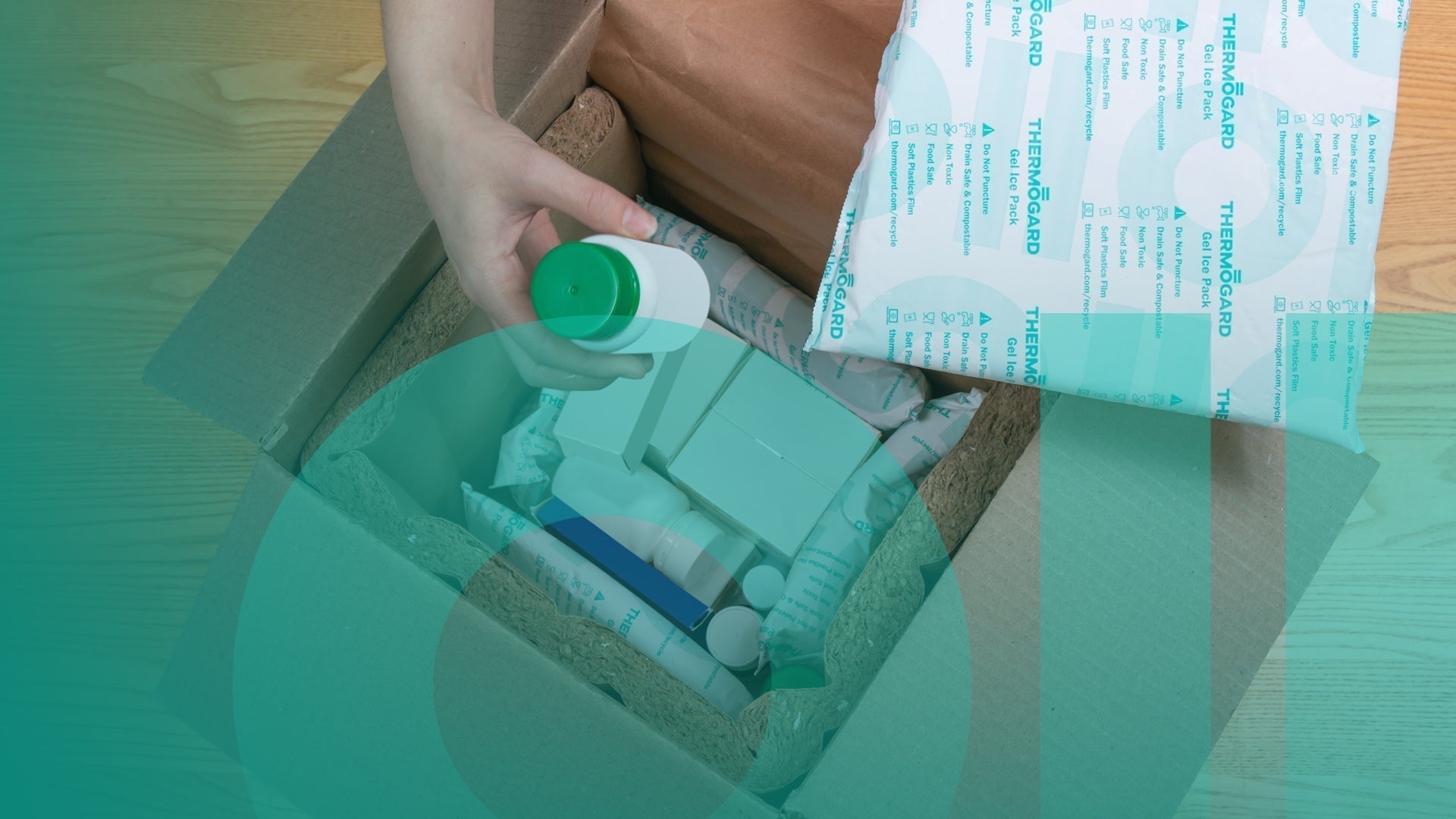
The configuration used an 11.5-inch x 9-inch x 12-inch corrugate carton with a 1.5-inch PaperShield Ultra A/B liner kit. Three 24 oz gel packs were arranged with two above and one below the payload. Two 0.5-inch honeycomb dividers controlled direct exposure to the frozen coolant, while paper dunnage fixed the vial in the center of the payload space and reduced unmanaged voids.
For qualification, packaging was conditioned at 21°C for 24 hours, the saline vial surrogate at 5°C for 24 hours, and the coolants at minus 25°C for 48 hours before a 10-minute bench period.
Temperature probes were placed inside the vial and in the surrounding payload space so product response could be assessed alongside internal air temperature. The completed pack out was then tested in a Thermogard thermal chamber against the ISTA 7E Summer profile.
By controlling insulation, coolant, barriers, void fill and conditioning as one documented system, Thermogard reduced operator variability and created a pack out that could be reproduced consistently in pharmacy fulfilment.
END RESULT
The PaperShield shipper maintained the vial surrogate within 2°C to 8°C for 36 hours and 55 minutes. Product temperature at the 36-hour point was 7.7°C, and the qualification recorded no deviations or exceptions.
The result established a documented pharmacy pack out using paper fiber insulation, standard gel coolant and simple protective components, while keeping the assembly compact and straightforward for operational teams.
The final configuration provided a qualified platform for 36 hour summer shipments, with a defined packing sequence that supports fast, repeatable execution in pharmacy environments.
GALLERY

Read more
Veterinary vaccines and medicines often pass through manufacturers, wholesalers, logistics providers, and regional depots before reaching a clinic. A common packaging standard across that network g...

The central challenge was consistency across 15 fulfilment sites. The client was already shipping temperature sensitive medicines at scale across North America, but variations in coolant conditioni...

A major member-based Australian pharmacy group sought a consistent cold chain packaging approach across its multi-state retail network.