


Standardizing Pharmacy Cold Chain Across 15 Fulfillment Sites
PROJECT BACKGROUND
The central challenge was consistency across 15 fulfilment sites. The client was already shipping temperature sensitive medicines at scale across North America, but variations in coolant conditioning, bench time, component tolerances and packing practices made it difficult to produce the same thermal performance site to site.
As a result, Thermogard was asked to redesign an existing sustainable insulated system around a 60-hour chilled shipping requirement. The technical target was 2°C to 8°C, but the broader objective was operational: standardize components and tolerances, align conditioning and handling procedures, and create a supply model that could support manufacturing, kitting, conditioning and logistics from a single source.
PROJECT REQUIREMENTS
The program began with an existing 2-inch insulated pack out that achieved approximately 31 hours in temperature. The new system needed to materially extend thermal duration while remaining practical to assemble at scale and avoiding a proliferation of site-specific components.
The design also needed to stay within practical limits for pack size, weight and cost while being simple enough to standardize across all 15 sites. Coolant mass, bench time, divider thickness, payload box dimensions and internal positioning therefore had to be evaluated as part of the complete system rather than optimized in isolation.
UNIQUE PROJECT CHALLENGES
Standardizing 15 sites meant Thermogard had to solve two problems at once: improve thermal duration and reduce the number of variables left to local execution. Differences in coolant condition, bench time, divider placement, payload box geometry and handling could all effect performance, so the pack out needed to be robust enough for repeatable training and execution across multiple fulfilment teams.
Thermal testing also showed that more coolant did not automatically produce a better result. Two 55 oz gel packs improved warm side endurance but introduced cold excursions, making payload protection and barrier design critical. Intermediate testing confirmed that divider thickness and payload geometry materially changed heat transfer, particularly after a change to payload box height.
The challenge was therefore to tune the complete pack out rather than maximize any one component, while staying within the client's limits for size, weight and cost and creating a process that could be reproduced across multiple fulfilment sites.
THERMOGARD SOLUTION
Thermogard used an iterative engineering program combining 18 chamber tests, more than 500 Thermal IQ simulations and over 50 sample kits. Each chamber pass or fail remained a definitive validation result, and every result was then used as another data point to fine tune coolant configuration, payload protection, divider thickness and geometry into a more robust system.
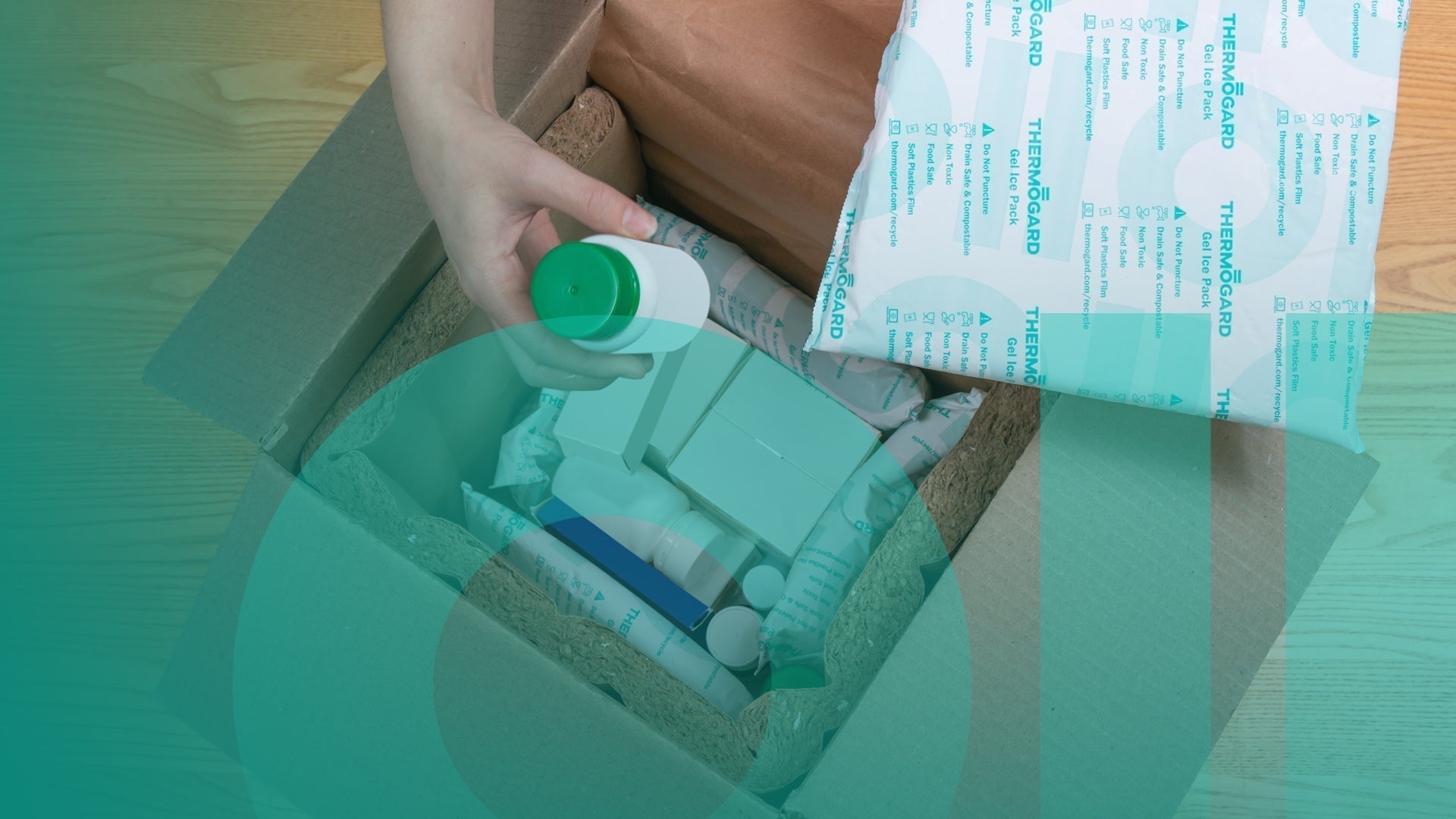
The resulting concept used an outer RSC carton, a 2-inch three-piece PaperShield Ultra liner, two custom sized 55 oz gel ice packs, PaperShield Ultra dividers and a dedicated payload box. The layout separated frozen coolant from medicine, centered the payload within the insulated cavity and created a repeatable packing sequence for fulfilment sites.
The work also extended beyond the shipper itself. Thermogard proposed a single supply structure covering manufacturing, kitting, coolant conditioning and logistics, reducing the number of variables left to individual sites and creating a stronger platform for SOP development, training and repeatable pack out execution.
VALIDATION
The latest concept was tested against a 72-hour ISTA 7E Summer profile using two saline filled vials as product surrogates. The payload and packaging began at 4°C, coolant at -5°C, and each vial was probed at its center so qualification reflected product temperature rather than air temperature alone.
The configuration maintained the payload between 1.5°C and 8.5°C for 53 hours and 20 minutes. Although it did not reach the original 60-hour, 2°C to 8°C target, the material improvement in performance from the 31-hour baseline was well within the customer's limits for pack size, weight and cost. Though 60 hours was easily achievable through increased insulation and coolants, the client ultimately opted to stick with the 53-hour packout, as this represented a key balance between thermal endurance and operational efficiency.
END RESULT
The program showed that performance was governed by the interaction between cold mass, payload protection, barrier resistance and payload geometry. The system was therefore refined for pack out efficiency rather than simply made larger or heavier, avoiding unnecessary material and reducing the risk of creating new cold side failures.
Operationally, Thermogard also defined a more standardized multi-site model with a common component architecture, repeatable conditioning logic and a pathway to single source manufacturing, kitting, conditioning and logistics across 15 sites. This reduced local variation and made the pack out easier to train, reproduce and support at scale.
GALLERY

Read more
Thermogard was engaged by one of the largest pharmacy shippers in the United States to develop a compact cold chain packaging solution for temperature-sensitive pharmaceutical shipments moving thro...

A major Australian pathology provider needed a more reliable way to move temperature sensitive diagnostic specimens across its collection and laboratory network. Thermogard reviewed the full transp...

A major member-based Australian pharmacy group sought a consistent cold chain packaging approach across its multi-state retail network.